• How Johnny Mnemonic’s Asian Eyes Reflect Cyberpunk’s Borderless World

    This blog post is about the surgery Johnny Mnemonic gets in the short story by William Gibson. The Johnny Mnemonic Master Blog Post is here.

    //

    Do you remember Johnny Mnemonic as the typical white guy played by Keanu Reeves in the a bad movie from 1995? You must not have read the book. Because in the book he’s a “Caucasoid” with Asian eyes. That’s a little different from the typical 1990s movie star look. The movie completely ignores that, but in the original short story it is a critical detail.

    The Plot So Far

    Our hero is Johnny Mnemonic. He has a silicon chip installed in his head that can be used for data storage. At the beginning of the story, he has information stored in his head that he needs to get rid of. But he doesn’t have the password. His boss does.

    //

    In addition to his cyber augmented brain, Johnny has a new face. He has a meeting with his boss to offload the stored data and get paid. But the information happens to be stolen information – stolen from the wrong corporation. That causes a problem for his boss, and his boss actually wants to kill Johnny. Johnny arranges to meet his boss under a fake name and he needs to show up to the meeting with a fake face to complete the ruse.

    Would You Get Plastic Surgery At Under The Knife?

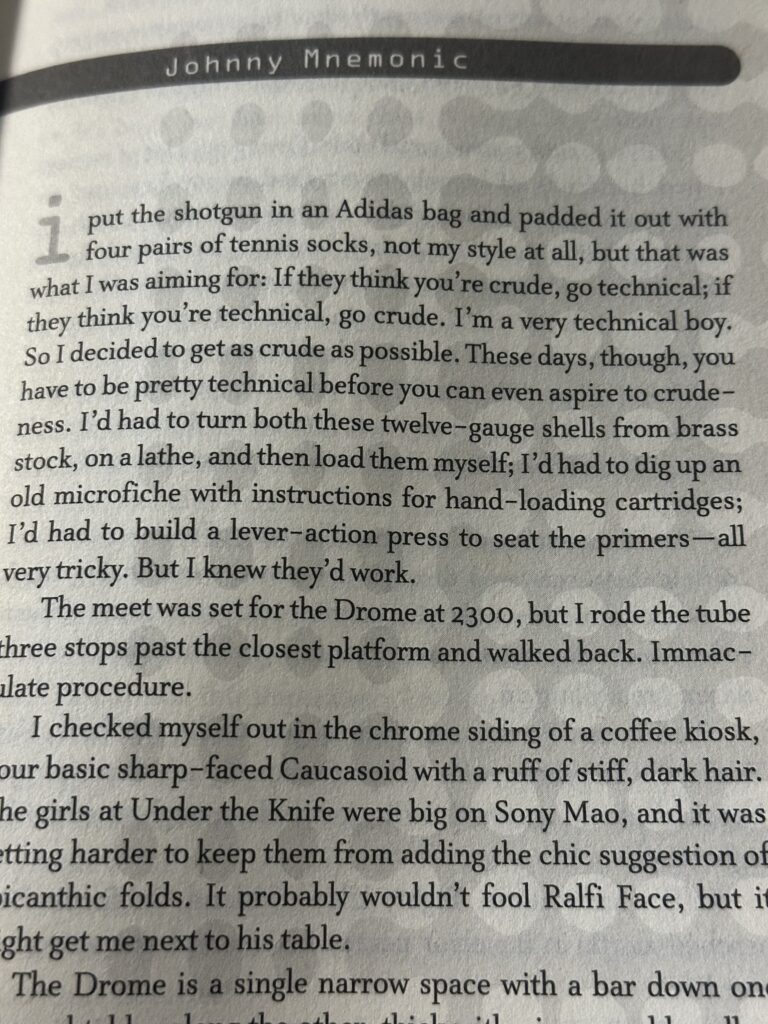
    He gets the plastic surgery done at a place called Under The Knife. Under The Knife isn’t some hospital. Under The Knife is just a random business that happens to do plastic surgery, like some businesses happen to sell flowers.

    //

    In this world, there are no licensed medical doctors, because the medical field, like all other fields, have been deregulated away. So who does Johnny’s surgery? Not a surgeon but just the “girls at Under The Knife.”

    The Girls At Under The Knife

    The use of the word “girls” is significant. It isn’t “I got my new face at some shop in mall.” Gibson emphasizes that is the nameless “girls at Under The Knife” who perform the surgery. This shows what happens when something becomes deregulated.

    //

    In the world of Johnny Mnemonic, ANYONE can just take hang a shingle and become a plastic surgeon. It need not be someone with education and training. It need not even be an adult. It can be just some girl, like some girl who works as a hair dresser – except in real life, the hair dresser actually has a license and works in a profession that is more regulated than the girls at Under The Knife.

    //

    These girls at Under The Knife like eyes with epicanthic folds – that’s the skin in the corner of the eyes Asians have. He can’t resist the girls suggestion of the Asian eyes just like he couldn’t resist getting the memory implant in his brain so he could charge high storage rates. So Johnny gets the Asian eyes.

    What Do The Eyes Represent? Why Are They Asian?

    It’s worth commenting on why the eyes have to be “Asian” eyes. In a lot of Gibson’s early cyberpunk, we see an Asian dominated world where some nameless MegaCity on the eastern seaboard of what is now the USA looks like Hong Kong. This is a reaction to the dominance of Japan in the early and mid 1980s. Japan doesn’t really dominate anything anymore, so it can be tempting to dismiss some of these Asian elements.

    //

    But don’t confuse the cyberpunk Asian aesthetic with what’s going on under the surface. The point Gibson makes over and over in these early cyberpunk stories is deregulation breeds a soulless anti-human corporate dystopia. That’s still true whether or not Asia is currently dominate.

    //

    So Johnny Mnemonic’s Asian eyes tell us that he lives in a world where getting a new face is just as easy as getting a new haircut. That could be do to advances in technology. Maybe that’s why some random girl can perform the surgery because the surgery is so easy now with advanced technology. Gibson doesn’t spell it out, but that’s one possibility.

    //

    But it doesn’t really matter how everything got deregulated. Only that it did get deregulated and what are the consequences of that deregulation. Here the consequences are that Johnny easily get a new face with new eyes.

    //

    It is important to realize that Gibson focuses on the eyes and not the rest of the face. With eyes being the window to the soul, Gibson is saying that such a deregulated world inevitably causes us to lose our soul because we are forced to sell our soul if we are to successfully compete in this deregulated, borderless world.

    //

    So, Johnny’s new eyes represent the effect of living in a world without any borders or rules, where the only objective is to maximize your earnings – even if that means losing part of your body and soul.

    //

    It is amazing that Gibson can convey this in only a few paragraphs.

    The Last Blonde

    I wrote a cyberpunk short story that tackles similar issues. Except instead of have the main character slide head long into artificial body parts, he resists any artifice at every chance. The story is called THE LAST BLONDE. See how it works out for him at www.blackflagliterature.com

    //

    You can also sign up to my newsletter by emailing me at newsletter@zekeberk.com

    +
  • Johnny Mnemonic Non-Spoiler Review

    This blog post is a non-spoiler review of the short story Johnny Mnemonic by William Gibson. For the Master Post of Johnny Mnemonic see here.

    //

    Johnny Mnemonic is a foundational classic of cyberpunk and indeed all of science fiction. Delete the cheesy 90s movie version from your brain. Johnny Mnemonic isn’t about some hero saving the world, like a thousand Marvel movies. It is a complex and rich story told with astonishing economy and density of detail. It’s a marvelous, visionary piece of writing that created the cyberpunk genre as we know it.

    //

    Most of the basic signifiers are there: high tech and low life, the mixing of human flesh and cybernetics, corporate assassins, drug use (either actual drug use or “cyberspace” as a drug-like mass hallucination). The only thing it misses is the racial mixing – what I call racial deregulation that comes up in New Rose Hotel that I talk about here. But everything else is right there on just a couple of dozen pages.

    Plot

    Our hero Johnny Mnemonic is a data courier. He has had silicon and cyberware installed in his head so he can carry data and charge high data storage fees. Some data has been stored in his head and he wants to download the data and get paid. But his boss/fence doesn’t want to meet with him because the data in Johnny’s head is stolen from the wrong corporation. So his boss/fence wants to kill him.

    //

    Johnny decides to meet the boss under a fake name and hash out a deal. The meeting doesn’t go as planned when a mysterious woman shows up. It is the famous Molly Millions with mirror glasses for eyes and razors coming out of her fingertips who is also at the heart of Neuromancer.

    //

    The second half of the story is devoted to hiding out from corporate assassins while trying to hack the password to Johnny’s storage in his brain. The second half also contains an interesting meditation on tech as a drug, especially what exactly all those people who have gotten surgical enhancements like Johnny and Molly are doing to themselves and their bodies and their humanity. Strong Black Mirror vibes, which are common in the cyberpunk genre, but which I think a number people overlook because a lot of people still like to “geewhiz” at the “cool” tech.

    Style

    The style is worth commenting on because Gibson is certainly known as a stylist and is seen as someone who is both a genre writer and a literary writer. This was the second piece of fiction he ever attempted, so his style is not fully developed, and you don’t really get the whole Gibson experience that you see in Neuromancer. Instead, this reads like a techno infused version of Robert Howard, with the story’s fast pace and straight-ahead plot.

    //

    I like the prose here. I strongly prefer it to the “look ‘ma, I’m a writer” prose that you would see a few years later in Neuromancer and New Rose Hotel, with its sky the color of tv and all that.

    Verdict

    Johnny Mnemonic is a must read whether you are a fan of cyberpunk, science fiction, or just fiction. This is where the cyberpunk genre – the last genuine movement in science fiction – began. It serves as more than a prequel to its more famous cousin, Neuromancer. It is a truly visionary statement that stands the test of time and rewards repeated readings of its richly detailed world and characters.

    //

    In further blog posts, I plan to delve into Johnny Mnemonic’s borderless world, the politics and economics behind that world, and the drug use and the tech abuse in that are a consequence of living in a world where all borders have been broken down.

    +
  • Johnny Mnemonic Master Post

    This is the master blog post for Johnny Mnemonic by William Gibson.

    Spoiler-Free Review of Johnny Mnemonic: here

    //

    How Johnny Mnemonic’s Asian Eyes Reflect Cyberpunk’s Borderless World: here

    //

    Why Is The Bouncer Transgender in Johnny Mnemonic: here

    //

    The Swastika and Aryan Race Rock in Johnny Mnemonic: here

    //

    Molly Millions Against The Blonde Henchman And The Golden Age Of Scifi: here

    //

    The Dolphin in Johnny Mnemonic is Hooked on Heroin, What is Johnny Hooked On? here

    +
  • Racial Deregulation in Cyberpunk – New Rose Hotel by William Gibson

    Have you ever read a cyberpunk story and noticed all the characters of different races mixing together? Did you think the author was being progressive and forward thinking? Boy, did you miss the fucking point. Racial deregulation isn’t kumbaya. It’s a mother fucking warning.

    Give me a hero, Give me Keanu

    I’m talking about New Rose Hotel by William Gibson.  It’s one of the original cyberpunk stories that defined the genre. The title refers to some shitty hotel by the airport our hero hides out in after he gets betrayed by some femme fatale. That’s the ending. But like all great cyberpunk stories, it starts in a bar. 

    Imagine this: some Keanu Reeves look-alike walking down a dark street under a polluted sky.  He walks through the rain and ducks under a bright neon sign into an underground bar.  The music is loud even from the street.  He bumps past the dark-skinned bouncer and worms his way through this large multi-racial blob of strangers talking, drinking, drugging, scheming.  He takes a seat at the bar.  He sits next to a slim, mid-twenties woman who is half Dutch and half Japanese.  They get to talking. To a liberal this might sound enticing – just think of all the possibilities – but it isn’t.  Because cyberpunk isn’t wish fulfillment. It’s a dystopia.  The racial mixing you see isn’t a feature; it’s a bug.

    They Promised Gadgets and Bliss, But the Future Smells Like Piss

    Cyberpunk isn’t about neon bars or jacking into the matrix or even cyberspace.  So, what is it about?  High and low.  High tech and low life is cyberpunk.  Nothing is nicely separated.  Everything and everyone is mixed together.  Long gone is the clean and sweet sci-fi of Star Trek where you are whizzing past other space ships around the galaxy.  In cyberpunk, you’re stuck on earth and can’t escape the blood and the guts and the piss and the shit.  Down here, if something is whizzing past you, it probably smells really fucking bad.  The real question is how did we get here?  How did we get to the point that 3 corporations run the world?  Deregulation, that’s how.  Once regulation is six feet under there isn’t anything to stop a few corporations from dividing and conquering and turning the world to shit.  And the racial mixing you see – what I call racial deregulation –  is just concrete visual evidence of that general economic deregulation. 

    “Dark European eyes, Asian cheekbones.”

    Her name is Sandii. Double I at the end. Quite unique. She’s a whore. Less unique. At any neon lit bar like this there has to be at least one fucking whore. This whore is “Eurasian, half gaijin, long-hipped and fluid in a Chinese knock-off of some Tokyo designer’s original.” Think about how the two parts of that sentence go together. The first part, about the Chinese knock-off of some Tokyo designer shows how nothing is safe, and secure. You could be a genius fashion designer, but your designs will just be copied and stolen, and mass produced by someone else to make Chinese knockoffs. Why? Why can’t the Tokyo designer prevent this? Why can some corporation just take a designer’s design and make a Chinese knockoff? Because of deregulation, that’s why. Whatever laws that should stop someone from stealing the Tokyo designer’s design has been deregulated the fuck away and now some corporation can do whatever they want.

    But don’t forget about the first part of that sentence, the part about Sandii being “Eurasian and half-gaijin.” She’s Eurasian – in other words she is neither European nor Asian. She is neither here nor there, but something in between. Her name also clues you in on this. “Sandii” sounds European phonetically, but with the double ii at the end her name tells you that she is very much non-European. She uses this inbetweenness to her advantage and our boy Keanu’s detriment. She tells stories about a childhood in Amsterdam that lull Keanu into a soft sense of security. Her dark European eyes sell it. She also uses her pretty Asian cheekbones to cozy up to an Asian scientist, who Keanu wants to use her to target. Unfortunately for our boy, she double crosses him. He’s left with nothing but her old .22, while he pines away for her in the New Rose Hotel. None of that would have been possible without racial deregulation. The femme fatale can only play both sides of the fence because of racial ambiguity and racial mixing.

    We used to be a proper country where you could flunk out of carpentry school and out-earn a lawyer.

    Gibson hated deregulation. But some people like it. It makes some people richer. But Gibson’s point was that it makes the average guy – in particular the average white guy who was reading science fiction short stories in Omni magazine in 1984 – worse off. He wasn’t wrong.

    Example. A few years before New Rose Hotel was published, Jimmy Carter and both parties in Congress passed a law to deregulate the trucking industry. Average pay in the industry dropped from $150,000 in today’s dollars to fifty grand a year. That’s deregulation for you. You personally couldn’t afford to work that job so the average trucker on the road is some guy from the other side of the world. So, a truck driver you went from a good union job to having to compete with a horde of people from the other side of the world. And if you were awesome and won that fucking competition, the grand prize is getting paid a third of what you did before deregulation.

    Another example. This one is famous. Harrison Ford loves to tell a story about him making $500 dollars a week as a self-taught carpenter before American Graffiti and Star Wars in 1972. The way he tells it, it’s supposed to be a story of grit and determination and how perseverance pays off. But it’s only those things if you are too lazy to a goddamn google search and see how much in today’s dollars 500 bucks is. And it turns out it’s almost $4,000. Each week. So, Ford was making over $200,000 a year as a self-taught carpenter. The average private sector pay from graduates from my law school is less than $140,000. A carpenter would not make more than a lawyer now, because the employment market has been completely deregulated. There are way too many guys from Mexico or wherever, each of whom will work for $50,000 grand a year so now the $200,000 job vanishes. Mass migration deregulated it away. I want to point out how in each of these cases there’s a racial as well as economic aspect to it. The wages go down because of a zillion new people from the third world who enter the market. Just like in New Rose Hotel, you can’t separate the racial from the economic point.

    You might wonder why am I talking about truck drivers and carpenters when our Cyberpunk hero is Keanu fucking Reaves – he’s some super smart hot shot hacker isn’t he? Let me break the bad news to you – it doesn’t fucking matter how smart our hero is. In this deregulated world he’s just another guy. That’s the point. That’s what it means to be high-tech and low life: everyone’s on the same playing field because everyone has the same tech. Everyone’s high tech and everyone’s a low life.

    In fact, in Johnny Mnemonic, another classic story that was published around the same time, Keanu has a memory chip implanted into his head and he has to deliver it to his boss. He is literally delivering something from point A to point B. He’s just another fucking truck driver.

    Hollywood swallowed the Blue Pill

    Cyberpunk shows how dystopian society becomes once deregulation is the law of the land. One of the prime ways it shows that is through the racial deregulation of its characters. But don’t tell Hollywood that. If you had just watched the movies that pass for cyberpunk you would have no idea that cyberpunk is about the bad side of deregulation or even that it’s dystopian. Instead, Hollywood thinks cyberpunk is about some super smart guy saving the world along with his perfectly racially balanced coworkers. Hollywood really thinks cyberpunk is just another stupid marvel movie.

    Having basically grown up on movies like The Matrix, Netrunner, Johnny Mnemonic, and Blade Runner I thought cyberpunk was cool gadgets centered around hacking into to something and, yes, a few corporations ran the world instead the of the Government like in Star Trek, but none of those movies captured the underlying reasons why the cyberpunk genre even exists. They get the aesthetic of neon bars and the Matrix as cyberspace but they don’t get what’s happening underneath the surface. And they ignore the racial element. And I guess they have to.

    Even the Hollywood of 30 years ago wouldn’t dare criticize racial deregulation. Instead, Hollywood’s politics requires them to fully endorse it. That’s why in The Matrix, Morpheus is a black guy and there’s also a couple of Hispanic guys in the crew. Hollywood’s view is that the deregulation where every race is thrown together to combat the big bad villain is good. Hollywood tells a story about how only by all races working together can the big bad villain be defeated. But that’s not cyberpunk. Cyberpunk says that racial deregulation is bad. In fact, the “Eurasian, half gaijin” women is what gets the hero killed. He falls in love with her and then she backstabs him and he’s left to hide out from some corporate assassins in the New Rose Hotel. Racial deregulation won’t conquer the villain. Racial deregulation is the villain.

    Actually going out and reading these original cyberpunk stories after growing up on Hollywood’s version is a hell of a wake up call. Almost like I had just taken Morpheus’s red pill. Because criticizing this racial deregulation goes against standard liberal thought, stories like New Rose Hotel are still deeply subversive in 2026. That’s what makes it Black Flag Literature.

    +
  • THE LAST BLONDE

    I uploaded my first story on blackflagliterature.com.

    The story is called THE LAST BLONDE.

    It’s a cyberpunk story set in the rural mid-west in the near future where racial deregulation was reached all corners of America.

    If you want to discuss the story comment on this post.

    Thanks for reading.

    +
  • Racial deregulation in cyberpunk / new rose hotel by william gibson

    I started a YouTube Channel.

    My first video is about how people completely miss the point of the cyberpunk genre. They think the diversity is a sign of the author being forward thinking and progressive. But that’s not what’s going. The diversity is a warning.

    /

    Anyways, here’s the link: https://youtu.be/3sUcd6AEsdA

    /

    You can comment on YouTube, but if you want to make sure I read your comment, just comment down below on this post.

    +
  • It’s hard to feel the future

    William Gibson’s The Winter Market

    /

    Published post Neuromancer, The Winter Market has a quasi-cyberpunk aesthetic with its run down market where people sell their wares and its futuristic technology where people’s dreams are commercialized by technology that turns their dreams into films.

    /

    The story is about a film editor who takes people’s dreams and turns them into films and then sells them. The main character meets a woman who has a debilitating disease that requires her to wear an exo-skeleton to walk around. The main character then decides to turn this woman’s dreams into a commercial film project. The main character plugs his brain into hers to see her dreams.

    /

    This is where the story loses me.

    /

    This plugging in is supposed to be some transformational experience that creates a connection between the main character and the woman dreamer. Without this the rest of the story doesn’t make any sense because otherwise why would the main character (and the reader) care about her? The story ends with the woman uploading her consciousness to a computer server and the main character is afraid the woman’s consciousness will contact him (which unnerves him because he doesn’t want to talk to someone who got cremated).

    /

    So, the whole story hinges on the relationship between the woman and the main character. And I’m not buying it. What’s the basis for the main character’s feelings toward the woman? It’s supposed to be the plugging in, but here’s how Gibson describes it: “Words. Words cannot. Or maybe, just barely, if I even knew how to begin to describe it, what came out of her, what she did…” The main character then goes on to explain what the dream looked like: “like your on a motorcycle at night, no lights but somehow you don’t need them … Amazing. Freedom and death, right there, right there, razor’s edge forever.”

    /

    And that’s basically it. That’s the four second dream that is so pivotal to the story. The main character describes the rush but do you feel it? Do you buy it?

    /

    I don’t. Any sort of “Words can’t describe what I’m trying to describe” is just awful writing. It is the writer’s job to describe things. Even if the main character himself couldn’t describe it, the reader should still be able to feel what the character goes through and just saying “words can’t describe it” is a miserable failure.

    /

    The writing tells me that the incident is “Amazing” without actually showing me that it’s amazing. That’s the problem and the problem is fatal to the story. With any futuristic technology like plugging in, the technology and its effects on people needs to be believable. Obviously, it’s hard to show a futuristic technology and its effects on people. It is much easier just to mail it in and tell the reader instead of showing them. But that’s not good writing. Good sci-fi writing will give the reader no choice but to feel the future.

    /

    The Winter Market is a miss. The voters that nominated this for the Hugo had low standards of proof.

    +
  • game of thrones could have used an ai actress

    An AI actress has been created and born. Mass outrage among the Hollywood creative community with actors condemning it. Hollywood talent agencies have said they will not work with her. Their argument is that creativity must be human centered. I think that misses the point. AI can still be human centered because there’s a human somewhere that is directing the AI. Furthermore, I think the criticism misses some of limitations in fully human creativity.

    /

    Everyone who watched Games of Thrones noticed the massive quality difference in the first 3-5 seasons and the final couple of seasons, with the final season notably weak. What started as an ultra-realistic critic of cheesy High Fantasy devolved into the type of show it was ostensibly critiquing. One of the most notable differences was how the show changed its approach to on-camera nudity.

    /

    “Fuck You, I’m Naked” was the overriding philosophy of the first 3 seasons. The show was very in your face about it and this nudity created a sense of ultra-realism that was unlike anything on TV. But the last 3 seasons had a very different attitude toward nudity. There was none. Or at least the nudity was minimal and safe. The most obvious example was when Arya finally gets a sex scene in the last season and there is really nothing shown. This matters. By refusing to show what was really happening, and only showing the safe and bowdlerized version, the show ends its critique of Tolkien and company. Gone was the punk rock principle of “I’m going to show you reality whether you’re ready for it or not.” And the show greatly suffered.

    /

    What does this have to do with an AI actress? Everything. Because the reason the show went safe is that the human actresses had gotten more famous and more powerful politically and refused to do more extensive nude scenes. Also, the general political environment had changed and with it changing attitudes of women’s nudity in film/tv. So, there was no way to keep the no holds barred nudity and with it the whole “Fuck You, I’m Naked” vibe. AI solves this problem. An AI actress’s feelings can’t get ruffled by requiring more nudity than she wants. So, if an AI actress had been available then GOT could have kept up its ultra-realistic critique of cheesy heroic fantasy and given us the ending that the show deserved.

    /

    Creatives should not default to the idea that humanity is always better than AI. Humanity has its downsides and in certain circumstances AI can circumvent those downsides to create something better than humans alone could create.

    +
  • hinterlands by william gibson

    Gibson’s Hinterlands is a short story from 1980-something. The story revolves around astronauts who pilot a small vessel to a point in space between Earth and Mars. Once they reach that point the astronaut hope to be taken by an advanced alien race. If they are taken, they disappear as if through a worm hole. The people then come back, maybe years later, often brining back some object (the first object was a sea shell).

    /

    It’s a good story with an interesting final twist. Something worth pointing out, however.

    /

    Gibson’s whole career is undisputably a reaction to 1950s optimistic Sci-Fi. He thinks that the gee whiz sci-fi is bullshit and that comes through in his famous cyberpunk stories, but also in his non-cyberpunk stories like Hinterlands. The Hinterlands of the title is our solar system and the effect of that is anti-human. “We’re not special! There is a civilization more advanced than us!” Gibson is saying. Very different from Captain Kirk whizzing from star system to star system.

    /

    Nothing inherently wrong with that but it is worth pointing out the internal inconsistencies of the “1950s were bad” people.

    /

    One inconsistency that strikes me is when he writes about the first astronaut that came back and how medical science took various samples of her skin/body so that the astronaut was “spread thinner and thinner until she came, in her martyrdom, to fill whole libraries with frozen aisles of precious relics. No saint was ever pared so fine.” You can only write that in a culture where religion actually means something. You would have to know that a Saint’s relics include the Saint’s body parts and not just personal belongings. You would have to know that these relics are actually venerated. You would have to actually believe a reasonable person would find some sort of meaning in these relics. You would have to not be grossed out by someone praying to an old Saint’s dead body parts. These beliefs are all incompatible with the current culture, a culture that Gibson helped build.

    /

    Of course, this was really just a throw-away line and not really relevant to the story. So you could read this and say that I am making too much a few lines in a single short story. But I think it is instructive not only of how writers work generally (we are all products of a culture – even when we’re writing to change that culture) but also how current sci-fi devolved into its current state. I can respect the current generation of sci-fi, despite how nihilistic it is, more than Gibson’s sci-fi because it is more honest and doesn’t attack the very thing that sustains it. It doesn’t saw off the tree branch that it’s standing on.

    /

    Of course, Gibson’s sci-fi was a lot better than the current sci-fi, but Gibson’s works were not without its flaws and reading his early stories some things really stick out.

    +
  • kirk and kimmel are downstream

    /

    Lots of talk about free speech lately but what people are missing is that both the Kirk shooting and the Kimmel firing/suspension are downstream of liberal capture. Once liberals captured every single cultural institution it became commonplace to say things like “Punch A Nazi” and there were no conservatives around these institutions to say “Maybe it’s wrong to commit violence against people you disagree with.”

    /

    So, someone was going to get killed.

    /

    Furthermore, once all actual conservatives had been purged from every cultural institution, the only conservative pushback could come in the form of government action. Enter the FCC. The argument that conservatives shouldn’t want the government to intervene on their behalf because one day the roles would be reversed falls on deaf ears because conservatives don’t have any power other than political power. They have no power in cultural/academic institutions because liberals completely took over those institutions and so conservatives have nothing to lose.

    /

    Having one ideology run everything is a recipe for an unstable and precarious society.

    +